
Soul Strip Ascension System: 20 Levels That Change How You Build Decks
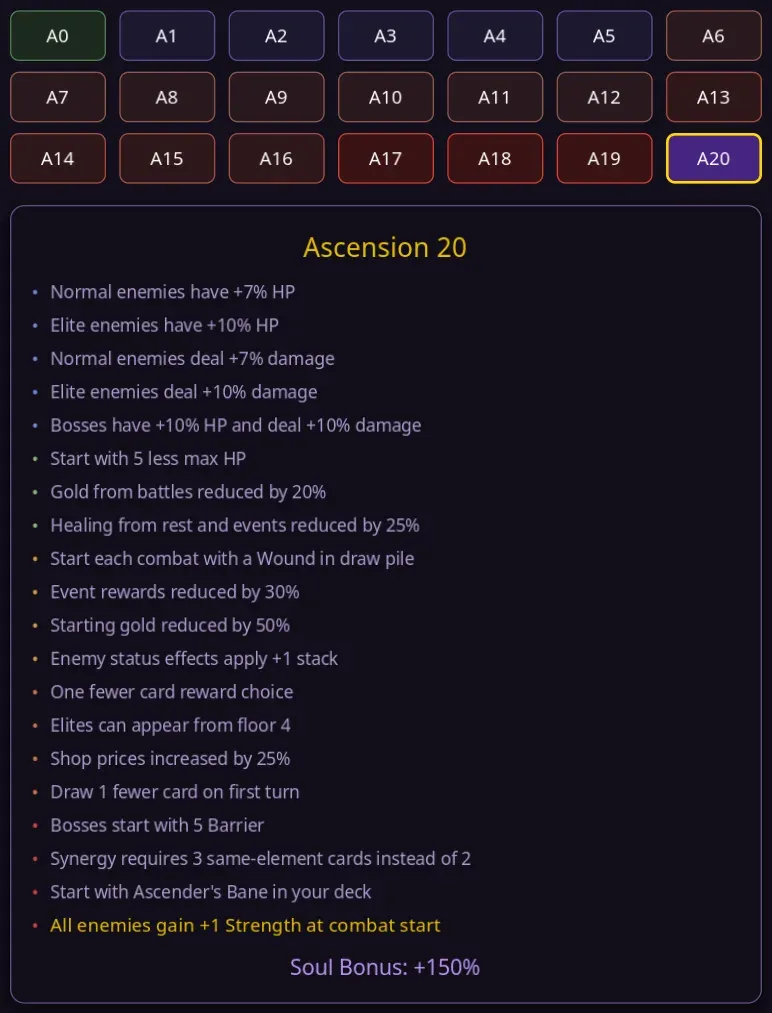
What Is Ascension?
Ascension is the endgame difficulty system in Soul Strip. Beat the game once on the base difficulty, and you unlock ascension level 1. Win at level 1, unlock level 2. All the way up to level 20.
Every ascension level adds a permanent modifier — and they stack. Playing at A12 means all twelve modifiers from A1 through A12 are active simultaneously. There’s no picking and choosing. It’s cumulative pressure.
The system exists because base difficulty has a shelf life. After a handful of wins, an experienced player has enough game knowledge to build strong decks consistently. Ascension is what keeps the game challenging past that point.
The Five Tiers
Instead of 20 levels of “enemies get bigger numbers,” the ascension system is split into five tiers. Each tier attacks a different part of your strategy.
Tier 1: Stat Pressure (A1–A5)
The warm-up. Enemy stats go up across the board:
- A1: Normal enemies +7% HP
- A2: Elite enemies +10% HP
- A3: Normal enemies +7% damage
- A4: Elite enemies +10% damage
- A5: Boss +10% HP and +10% damage
If your deck was solid on base difficulty, it still works here. You just have less margin for error. Think of it as a tighter version of the same game.
Tier 2: Resource Pressure (A6–A8)
Now the game starts cutting your safety net:
- A6: Starting max HP reduced by 5
- A7: Gold from battles drops by 20%
- A8: Healing from rest sites and events reduced by 25%
The same deck, the same fights — but you can’t afford to take as much damage, you can’t buy as freely, and you can’t heal your way out of mistakes. Resource management becomes a core skill, not an afterthought.
Tier 3: Adaptation Required (A9–A12)
This is where strategies start breaking:
- A9: A Wound card is shuffled into your draw pile at the start of every combat
- A10: Event rewards reduced by 30%
- A11: Starting gold halved
- A12: Enemies apply +1 to all status effect stacks
A9 is subtle but persistent — that Wound clogs your draws every single fight. A12 is where you feel real pain: every Poison, Vulnerable, and Weakness the enemy applies hits harder. Builds that relied on tanking debuffs and healing through them stop working.
Tier 4: Expert Territory (A13–A16)
Build strategy itself changes:
- A13: Card reward choices reduced by 1
- A14: Elites start appearing from floor 4 (instead of midway through the act)
- A15: Shop prices increase by 25%
- A16: First turn of each combat: draw 1 fewer card
A13 means worse drafting luck — fewer options, harder to find that key card. A14 means elites show up before you’re ready. A16 is the one that hurts most: your opening turn is weaker in every single fight. Combos that needed a full hand to set up on turn 1 no longer work.
Tier 5: Mastery (A17–A20)
Core mechanics get altered:
- A17: Bosses start combat with 5 Barrier stacks
- A18: Synergy threshold raised from 2 to 3 cards per element
- A19: Ascender’s Bane — an unplayable, unremovable card added to your starting deck
- A20: All enemies gain +1 Strength at combat start
A17 means you can’t burst down bosses immediately — you have to deal with 5 damage reduction first. A18 is the most impactful single modifier in the system. The base synergy threshold is 2 cards of the same element per turn. At A18, it’s 3. Your carefully tuned mono-element deck suddenly needs 50% more matching cards per turn to trigger bonuses. The entire build math changes.
A19 adds permanent deck pollution. Ascender’s Bane can’t be played, can’t be removed — it just sits in your deck, diluting your draws forever. A20 means every enemy starts stronger. Floor 1 goblins hit like floor 5 goblins used to.
Why Tiers, Not Just Numbers
The most common approach to difficulty scaling in roguelikes is linear stat inflation. Enemies get X% more HP per level. It works, but it’s boring — the optimal strategy stays the same, you just need to execute it better.
Soul Strip’s tier system means the optimal strategy shifts every few levels. What works at A5 breaks at A9 because Wound cards change your draw consistency. What works at A12 breaks at A16 because your opening hand is smaller. What works at A16 breaks at A18 because the synergy math changes fundamentally.
This is intentional. Each tier targets a different pillar of deckbuilding:
| Tier | What It Attacks | Player Response |
|---|---|---|
| 1 | Raw power | Build tighter decks |
| 2 | Resources | Manage HP and gold carefully |
| 3 | Consistency | Adapt to deck pollution and weaker rewards |
| 4 | Flexibility | Win with worse cards and faster elites |
| 5 | Core assumptions | Rethink synergies and build foundations |
The A18 Threshold
A18 deserves its own section because it’s the single biggest difficulty spike in the system.
The base synergy threshold is 2: play 2 cards of the same element in one turn, and you get a free bonus (Fire deals extra damage, Ice gives extra Block, etc.). Mono-element decks are built around triggering this every turn.
At A18, the threshold becomes 3. Suddenly, a 15-card mono-fire deck that reliably drew 2 fire cards per turn needs to draw 3. You either need a smaller deck (more consistent draws), more card draw effects, or you accept that synergies trigger less often and build around raw card value instead.
It doesn’t make the game harder in the traditional sense — it makes it differently hard. And that’s the goal.
Win Rates
A20 had a 4% win rate across testing. For context, base difficulty sits around 60-70% for experienced players, and A10 is roughly where most players settle into a comfortable challenge.
Most A20 deaths happen around floors 25–30. That’s the point where floor scaling catches up to underpowered decks — if your build isn’t strong enough by mid-Act 2, you’re probably not finishing the run.
Try It
The demo covers Act 1 on base difficulty. Ascension unlocks after your first win.
More about the game: Soul Strip landing page

Soul Strip: Waifu Card Battler
A deckbuilding roguelike where every card is a waifu with her own element and personality. Battle through dark fantasy, craft combos, collect and level up your favorites.
Wishlist on Steam